I was working as a copywriter in an ad agency in New York. I was doing well. I had won an Emmy award for a commercial I had written. My boss had given me a book as a present. In the inside cover, he wrote: 'one day, all of New York will know your name'.
I had a job I was good at, friends, a little apartment, a cat and gym membership. I also had a green card and a shelves full of books I had collected from Shakespeare books, Strand books and even Barnes and Noble. I had a handsome, intelligent, hardworking boyfriend who lived in Germany. So I quit my job and said goodbye to my friend and gave away my books.
I got on a plane and went to live in Germany where I had no friends and no job. In retrospect, it seems like a bad decision.
My handsome boyfriend picked me up from the airport and took me back to his apartment. It was in an industrial area behind the train station. It had fluorescent green sofas and a wall-to-wall carpet to match. There was no mat under the carpet so it felt hard underfoot. There was no fridge. There was tinned meat and beer in a cool box. There were no shops around or bookshops and restaurants like in New York. Then the handsome boyfriend went back to work.
He said he didn't want to get married. I said I did. I needed to because I didn't have a visa to work in Germany. I wanted to marry and have children with him. That was my plan.
On the day I arrived in Germany, he came back from work very late. The next day, he went back to work and I went back to the airport to pick up some boxes I had sent from New York. It was tricky finding my way around that part of Frankfurt airport because I couldn't say much in German. But I managed, and I came back to his apartment with the boxes in a taxi. I was brave, but not brave enough.
A week after I arrived, he had a business trip for a few days in Berlin. I wanted to go with, but he thought it wasn't a good idea because he would be working very hard. So I stayed alone in Frankfurt in his apartment with the green sofa and hard floors, behind the train station. I stayed alone in a city where I didn't know anyone. And couldn't really speak the language. So I did what I usually do in those situations. I drank a lot of brandy and Coke. I wrote and I cried. The drunker I got, the more it hurt and the worse I wrote.
It was like that for three days.
Now when I think back to that scorched earth time, I wonder why I didn't gather myself, pack my stuff and take a taxi to the airport. I could have bought a ticket back to New York or to Cape Town. Why didn't I? I could have ended that pain. Why didn't I leave. Why did I think I had no options? I was the woman who had won awards and who had retrieved her boxes alone from Frankfurt airport. I wish I had been brave enough to have left then. I wish I had been imaginative enough to see a different future for myself. I imprisoned myself with a picture of the life I wanted at any cost. I stayed and I stayed. I wish I could tell that crying, drunk, lonely woman to get up, pack up and get a taxi back to the airport. I want to tell her she is worth more. I want to tell her that there is some shit that you don't have to take. But even now I don't know where to tell her to go once she gets to the airport because she is really can't go backwards, and there is no future yet. I see her scanning departure times for London, New York, Cape Town and not knowing where to go.
So I stayed, and I waited for him to come home. And he did. We got married and had three children. It took me another 26 years to figure out where to go and how to get there, but I finally did it. I live with my youngest daughter now, in a tiny house in London. I have a lovely job, kind friends and full bookshelves. I'm still working on the gym membership.
Monday, 13 August 2018


Tuesday, 10 April 2018
A town called Luck

Tomorrow night, on Wednesday 11th April, for Yom HaShoah,
I am participating in the Yellow Candle project that helps remember individual lives of the six million Jewish people who were murdered in the genocide
we call the Holocaust.
I took a candle at random from the hundreds given out at
shul on Sunday morning.
All it said on
the little card was this:
Remembering Perla
Kardasz of Luck
Who perished at Luck
1942
Aged 8
I wanted to know a little bit about the child I was remembering,
but this is all I could find out about Perla’s life. She had two parents who were called Jacob and
Tzippora, and a sister called Nechama.
Her parents must have had enough money to put a pretty bow on her head
and have her picture taken when she was around two, and that picture was kept
by her aunt, along with details of her address, and when and where she was
murdered.
I looked up the strangely named town called Luck, and I
found out how Perla died.
Luck was a town in eastern Poland that according to a Polish
census of 1931 was 48.5% Jewish.
On August 19 1942, 17,000 Jews were rounded up by Nazi Orpo
police and local Auxiliary police over a four day period. They were assembled in the town square and
taken by trucks to the Gorka Polanka forest.
They were shot into the prepared trenches. Local residents were required to help dig the
trenches beforehand and to bury the bodies afterwards. Thousands of Jewish men, women and children were
executed at point blank range.
Among
them was a little girl called Perla Kardasz.
 |
| Testimony given by Perla's aunt |
 |
| A German Orpo policeman near the mass grave at Gurka Polanka after the murder operation |
Wednesday, 11 October 2017
I don’t care about Harvey Weinstein
Leah Vincent wrote recently in the Forward about ex-Orthodox
women who must learn to say no. She
understood that the dance of dealing with sexual advances from men was complex,
and has to be learned in the real world. I learned about this dance early on in my
life, and so I am not shocked by Harvey Weinstein. Or any of the taxi drivers, professors, colleagues, relatives, friends or strangers that propositioned
me, masturbated in front of me, tried to rape me, ogled me, fondled me or honked at me. What
surprises me is that people are shocked when it happens. Their desire for
retribution surprises me. The energy it mobilises in the Twittersphere and
the ensuing virtue-signalling, hand-wringing and demonizing surprises me.
I don’t think I’m the only woman who had an uncle who hugged
her too closely. Or went to the beach as
a teenager and saw a man masturbating behind her. Or who bathed in the beautiful hot springs in
Pamukkale, and saw another wanker in action, his eyes fixed on me and my
friends. I’ve had
a relative that wanted to be touched, a client that tried to force me to have
sex, a friend that fondled my arse and a licenced English cab driver in London
ask me for a blow-job.
I have hundreds of these stories and I bet most women
do. I don’t know if Orthodox women in
thick, black stockings and long sleeves get honked at in the street by men in
cars, but I know that I get honked at, whistled at and told to smile, whatever
I wear. The men
that do these things are not monsters. They are often kind, interesting, generous and
talented human beings, and I try not to limit my world to people who never
offend me. I don’t see myself as a
victim.
There’s a beautiful Rabbinic concept describing two worlds
of Halacha, the b’diavad world
meaning after the event or what happens in the real world, and the hatchilla world meaning every that
happens beforehand in the ideal world.
In the ideal world, no woman would have to deal with sexism, and men and women would live and work
together in mutual respect. But in the mixed
b’diavad world I live in, women have
to learn to punch, duck and dive, pick their battles, and to believe they have
the right to say no. There’s another
thing about the b’diavad world; I
only have so much time and energy to focus on the issues that truly bother
me. The problems of white, privileged, educated
women who want to become actresses are not top of my list.
The real crime is that there are millions of girls in
Sub-Saharan Africa who will never see the inside of a classroom. The real victims are poor women. Two thirds of the girls in Niger are married
before they are adults. Half of the
women living in Haiti’s capital city slums have been raped. Four
and a half million destitute and powerless women around the world are
trafficked for sexual use. In Trump’s
America, women’s reproductive rights are under assault, with particular impact
on poorer women. These are the issues that enrage
me. I care deeply about a woman’s right to choose, to be
educated and to be free. I’m too busy to care about Harvey
Weinstein.
Wednesday, 13 September 2017
Avraham

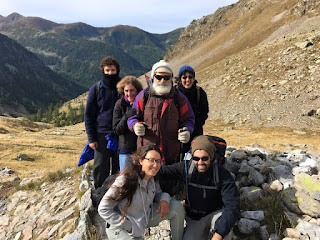
I was hiking the Marche De La Memoire again this weekend. Walking with us was a lovely man called Avraham. He had done this hike before. The last time was in 1943 when he was four years old. He remembers he was given a little walking stick and he walked from St Martin de Vesubie with his family and 800 other Jews, up to the top of the Col Fenestre and down the other side into Italy. When they got to Italy many of the refugees were arrested by the Germans and taken to Aushwitz where they were killed. Among them was Avraham's father who had gone to look for food for his family. The rest of the family hid in a hut, but they were found when a child cried. Avraham's mother gave him to an Italian Catholic woman for safe keeping. And so he survived and ultimately made his way to Mexico and then to Israel. He has two daughters in israel now, and five grandchildren who live in Israel and have served in the Israeli army.
I walked with his family on the long walk to the top. His granddaughter said the hike was a breeze without being weighed down by her rifle and her heavy flak jacket.
They were kind people; warm and thoughtful of their grandfather whom they called Papito. Avraham walked slowly and took many breaks but was generally cheerful during the tough three hour hike. I was walking with his grandson, Rafael, taking about Israeli music and poetry when Avraham called to him. "Tell me some good news Rafael!"
Rafael answered: "we have a state, Papito, we have a state."
Rafael answered: "we have a state, Papito, we have a state."
Avraham and the rest of us made it to the top of the mountain. A young French rabbi said Kaddish for the dead and blew the shofar. Avraham said shehechianu in a trembling voice. He was grateful. He had come a long way.


Monday, 17 April 2017
Remembering one

This is Therese Klau. She is 36 years old and she has just
given birth to her second daughter. I know these things because that infant grew up and kept four boxes full of old photos and letters which are now
available on line for anyone to look at.
This is what I could tell from reading the letters and
looking at the photos. Theresa
was married to Dr Oscar Klau, a lawyer who was seven years older than her. She had two sisters and an elegant mother with
white hair called Bella.
Theresa lived
in Frankfurt and signed her name ‘Resa’.
Her oldest daughter, Helga, was born 11 years before Ursula. Before the war, the family went on holiday in
Davos, St Moritz and even saw the pyramids in Cairo. In the photo above you can see the flowers
around her bed, the comfy cushions and decorated cottons and satins. You can see these things for yourself. You could think that a life that like would
keep you safe. Looking at this picture, of the infant Ursula in her mother’s arms,
it’s hard to imagine that Resa could die thirteen years later; unwashed, sick
and starving at the end of a long train journey at the end of the war. But
that is what happened. It’s shocking
that that could happen and how hard to stop that from happening once it starts.
Resa and her family tried hard to escape Nazi persecution by
moving from Frankfurt to Switzerland and then to Amsterdam in 1936, but to no
avail. The family was taken to Westerbork
transit camp from where Jewish people were then sent on by train to the death
camps. 60,330
people were sent to Auschwitz. Most were
gassed on arrival. One of those people was
Resa’s elegant, white haired mother, Bella. 34,313
people were sent to Sobibór. Very little is heard about that death camp because
all the people sent there were killed on arrival. 4,413 people were sent to Bergen-Belsen. Three of those people were Resa, Oscar and
their 12 year old daughter Ursula who were sent there in February 1944. Oscar
died there a few months later.
As the war was coming to an end, Himmler decided
to send three train-loads of Jews from Bergen-Belsen to Theresienstadt. The
last train left on April 9 with 2,500 people inside including Resa and her
twelve year old daughter. Two weeks later the train was abandoned by the
driver and guards in Troebitz.
Squashed, starved, and without drinking water
or toilets, 133 people did not survive the journey and were buried near
the railway tracks. Another 320 people
died of disease, starvation and exhaustion after being liberated. Resa Klau was one of those. On
May 7, 1945, on the same day, that Germany signed an
unconditional surrender at the Allied headquarters in France, Resa Klau died
in her thirteen year old daughter’s arms.

As part of the Yellow Candle project to remember individual
members of the Holocaust on Yom Hashoah on April 23rd, I was given Theresa
(Resa) Klau-Altheimer. There are still many more candles available
from New North London Synagogue that can be picked up on Wednesday, April 19
between 7.30 and 9.30 pm and on Sunday 23 April between 9 and 11.30pm.
 |
| From Helga, the oldest daughter to an American relative. She calls her sister 'Uschu' |
 |
| from the family album |
 |
| A letter from Helga to a relative where she describes her mother's death as told to her by her sister. |
 |
| Oma Bella |
Sunday, 9 November 2014
Music of the spheres

This is Felix Mendelssohn's Violin Concerto in E Major.
I was
listening to its closing notes today on my phone as I was running through
Kenwood and it caught me by the throat. I played it over and over. I tried not
to sing along loudly as I ran among the orange leaves on the muddy path.
But as much as those notes have that power to make me look
like a crazy lady in a London park, I know that they are not universal truth;
they only emerge from universal truth, as an expressed version of that
singularity. The only absolute version
of that singularity is silence.
The rest is interpretation, which is just as well really because the silence from which the music emerges is not directly communicable.
Words are not the thing.
The notes are not the thing. The skills of the violinist are not the
thing. My iPhone is not the thing. The gaps between
the notes are not the thing because even silence itself is really only an
experience of humans who aren't experiencing sound in the moment. Everything we experience in life is
an interpretation of the thing.
Here’s what I believe deep down, that music is beautiful because
we are alive to hear it. And that if I
feel like it, I should sing along loudly, without worrying too much about looking like a
crazy lady.
Tuesday, 16 September 2014
There are many ways to remember
 |
| Participants of Marche de la Memoire, September 2014 |
Reading about the Holocaust is like staring at the sun – you
can only look at a tiny piece or you will damage yourself.
The numbers are too big. The actions are too terrible. The
overview is terrifying. I try not to
look too much.
This September I couldn’t avoid seeing a little. Along with two other members of my synagogue,
I walked the annual Marche de la Memoire from St Martin de Vesubie in France, up
a steep and rocky mountain path in the Alps, and down the other side towards Valdieri in
Italy.
It is a challenging hike, but not too tough to notice the carpet
of pink flowers on the rocky ascent.
I have no idea what they are called – they were just small, pretty,
Alpine flowers and I imagine they bloom there every year at the same time in the late summer.
At the top of the mountain, we gathered with hundreds of
French and Italian people, remembering atrocities done there once, and atrocities
still done around the world.
On the stones behind us, there were photos of some of the Jewish
children of the area who had been captured, and killed at Auschwitz.
Apparently in previous years, someone had said Kaddish, but not this year. This year, an Italian girl read a poem she had
written and another played Hatikvah on her violin. A historian, eyewitnesses and a survivor
spoke. They read out the names of some of the murdered children.
They played Hatikvah again.
A few people hummed along. I felt
like I was the only one singing.
A few of us put a stone onto a pile of stones on the peak. It is our way to remember by leaving a stone on the gravestone.
 |
| Behind the speakers, photos of some of the murdered children were wedged into the rocks. |
Remembering the Jews
of St Martin de Vesubie
In September 1943, nearly 4 million European Jews had
already been murdered. Some were working
as slaves. The rest of the Jews of Europe were hiding or running. Nowhere was
safe for very long.
One tiny area became a haven for a few months. South East France, under Italian military
control, refused to surrender Jews to the German SS or to the French Vichy
administration.
1,200
Jewish refugees made it to the safe Italian zone and were moved to St
Martin de Vesubie. With support from Jewish charities like the Joint,
they spent that summer living as free
Jews. They established
schools and synagogues. They sat in cafes and organised dances.
To get there, all of them had made hundreds of critical decisions
-who to trust, when to go, when to hide, who to pay. On the 8th of September 1943, there
was another critical decision to be made.
Italy had surrendered to the Allies. The Italian occupying
forces in France, who had protected the Jews for ten months, began to retreat
home over the mountains.
1000 of the Jews from St Martin de Vesubie decided to go
with them. For three days they hiked over the Alps hoping to meet Allied troops
on the other side. It was a hard climb,
carrying small children and bundles of belongings. Some dumped their
belongings as they went. Some turned back.
But the Allies weren’t yet there to save them and they were rounded up by the Germans.
One third of the Jews that made the trek were arrested, deported to Auschwitz and killed. Two thirds went into hiding in Italy.
 |
| Cairn at the top of the Col |
Remembering a journey
Serge Klarsfeld's French children of the Holocaust outlines
what is known about the children taken on the 75 massive train convoys that went
from France to the death camps.
It lists
the names and ages of the children, as well as where they were taken from.
(If you want to break your heart, look at the photos of the some
of the children)
Here is the description for convoy 64 which left Drancy on December 7, 1943:
Here is the description for convoy 64 which left Drancy on December 7, 1943:
Convoy 64 deported 156 children - 79
boys and 77 girls. As with those deported on convoy 62, most had been arrested
in the countryside. Almost half were brought from a gathering point in the Côte
d'Azur: they had fled St.-Martin-de-Vésubie, on the French side of the border
with Italy, into Italy, only to be caught by Germans newly occupying the
Italian towns.
The entire list of the children on convoy 64 is given.
I can see two
names from the long list.
Joseph and Suzanne Katz aged eight and five. Their last
address is given as St Martin de Vesubie.
There are no photos of them.
There are no photos of them.
Remembering in hope
 |
| Hatikvah, or Hope, is the national anthem of Israel |
As long as Jewish spirit
Yearns deep in the heart,
With the eye turning east,
Looking towards Zion
Our hope is not yet lost,
The hope of two thousand years,
To be a free nation in our land,
The land of Zion and Jerusalem
Remembering one child
.JPG) |
| Germaine Steinlauf has no headstone on this earth, but for one hour a year, she has a mountain. |
Germaine was born in Nice, in the South of France. When she was 12, she was deported to
Auschwitz by train which left Drancy on February 10, 1944. There were 1,500 people on that convoy, of whom
295 were children.
She was one of the 16 Jewish girls taken from her school in
Nice.
She was one of the 11,400 Jewish children who were deported from
France to death camps in Europe by train.
The train cars were tightly packed. There was no food, water
or toilets.
On arrival at Auschwitz, she was selected for death and gassed
immediately. Her body was burned.
Her train, convoy 68, was one of 75 train convoys from
France to the death camps.
Auschwitz was one of the death camps.
The death camps were one of the methods used to kill Jewish
people.
France was one of the thirteen countries where Jewish people
lost their right to live.
Germaine was one of the one million Jewish children murdered.
She was one of the six million Jewish people who were
murdered.
Most of the bodies of the six million were burned or thrown into mass graves.
Most have no headstones on earth. Most left no photographs of their lives. Entire families were murdered with no one left to remember them.
Most of the bodies of the six million were burned or thrown into mass graves.
Most have no headstones on earth. Most left no photographs of their lives. Entire families were murdered with no one left to remember them.
It is too much to fathom.
Remembering where we are
There are many ways to remember. And none of us can remember the whole story.
It is too big and too terrible.
All we can do is look at a tiny bit and pass it on. Like placing a small stone on a cairn on a stony mountain, to remind people that come along later that there were people that were once here , and that their memory is still part of our story.
Their lives counted and their anguish was seen.
They are not forgotten, and we are not lost.
There are many ways to remember. And none of us can remember the whole story.
It is too big and too terrible.
All we can do is look at a tiny bit and pass it on. Like placing a small stone on a cairn on a stony mountain, to remind people that come along later that there were people that were once here , and that their memory is still part of our story.
Their lives counted and their anguish was seen.
They are not forgotten, and we are not lost.
 |
| The incredible flowers on the path up to Col de Cerise |
A documentary about the flight of the Jews from St Martin de Vesubie was made by Andre Waksman, whose own family survived the Holocaust in the Italian zone, is easy to download:
Photo credits: Bruce Rigal and Eric Weger
Subscribe to:
Posts (Atom)